Locknuts
Locknuts are constructed to resist loosening when subjected to vibrations or axial loads. A prevailing torque locknut achieves its “locking” action not through additional nuts or bearings, but through a controlled distortion of its threads or a locking element that’s been built into the nut.
Click a button below to learn about specific locknuts or keep scrolling for more.

Nylon Insert Locknuts
Nylon insert locknuts, also called nylocks, use a nylon collar or insert to prevent loosening due to vibration. When the nut is tightened, the nylon insert deforms elastically around the bolt’s threads, creating friction that prevents the nut from rotating or backing off.
How They Work
- Nylon nuts have a nylon collar or insert at one end.
- The nylon collar has a slightly smaller diameter than the threaded bolt or screws it’s paired with.
- When the nut is tightened onto the bolt, the bolt’s threads deform the nylon insert.
- This creates friction, which holds the nut in place and stops it from loosening, even when exposed to vibration.
Key Characteristics & Advantages
- Vibration Resistance: The nylon insert makes these locknuts especially resistant to loosening from vibrations and shocks.
- Temperature Stability: Nylon nuts maintain their locking capabilities in a wide range of temperatures, up to 250°F (121°C).
- Reusable: Nylon nuts can be used several times without compromising their locking effectiveness. However, they should be replaced when the nylon insert appears damaged or if the nut can be rotated by hand.
- Grades: The nylon is available in both inch and metric sizes, with options for steel and stainless steel.
Common types of nylon locknuts include:
- Machine Screw inch sizes - NM Series
- Machine Screw, Jam (thin) inch sizes - NTM Series
- Standard Hex inch sizes - NE Series
- Standard Hex, Jam (Thin) sizes - NTE Series
- Heavy Hex inch sizes - NU Series
- Heavy Hex, Jam (Thin) - NTU Series
Basic Dimensions
| Size | Width Across Flats | Thick Max | Jam Thick Max |
|---|---|---|---|
| 6 | 5/16 | 0.188 | 0.140 |
| 8 | 11/32 | 0.239 | 0.187 |
| 10 | 3/8 | 0.249 | 0.187 |
| 1/4 | 7/16 | 0.328 | 0.218 |
| 5/16 | 1/2 | 0.359 | 0.265 |
| 3/8 | 9/16 | 0.468 | 0.281 |
| 7/16 | 11/16 | 0.468 | 0.328 |
| 1/2 | 3/4 | 0.609 | 0.328 |
| 9/16 | 7/8 | 0.656 | 0.374 |
| 5/8 | 15/16 | 0.765 | 0.406 |
| 3/4 | 1-1/8 | 0.890 | 0.421 |
| 7/8 | 1-5/16 | 0.999 | 0.484 |
| 1 | 1-1/2 | 1.078 | 0.578 |

Stover Type Locknuts
Stover locknuts are all-metal hex nuts designed to resist loosening from vibration and shock. The locknut design has a conical top and a flat bottom bearing surface with chamfered corners.
How They Work
- Stock locknuts create a “prevailing torque” or friction between the nut threads and the mating bolt.
- This friction is generated by intentionally distorting or deforming the threads near the top of the nut.
- The distortion creates resistance to rotation. This resistance makes it more difficult for the nut to loosen, even under severe vibration or shock loads.
Key Characteristics & Advantages
- All-metal construction: Stover nuts are made entirely of metal, making them ideal for high-temperature applications where nylon inserts may melt or degrade.
- Top Locking: The locking action is concentrated at the top of the nut.
- One-way installation: Since the locking feature is at the top, stover locknuts are installed in one direction, with the conical top facing away from the assembly.
- Industries: Stover locknuts are often used in the automotive, agricultural equipment, and metalworking industries.
- Reusable: While stover locknuts can be reused, their prevailing torque capacity may decrease with repeated use.
- Grades: Marshall Sales offers Stover Nuts in Grade C.
Basic Dimensions
| Size | Width Across Flats | Thickness Max | Thickness Min |
|---|---|---|---|
| 1/4 | 7/16 | 0.226 | 0.212 |
| 5/16 | 1/2 | 0.273 | 0.258 |
| 3/8 | 9/16 | 0.337 | 0.320 |
| 7/16 | 11/16 | 0.385 | 0.365 |
| 1/2 | 3/4 | 0.448 | 0.427 |
| 9/16 | 7/8 | 0.496 | 0.473 |
| 5/8 | 15/16 | 0.559 | 0.535 |
| 3/4 | 1-1/8 | 0.665 | 0.617 |
| 7/8 | 1-5/16 | 0.776 | 0.724 |
| 1 | 1-1/2 | 0.887 | 0.831 |

Serrated Flange Nuts
Serrated Flange nuts feature a wide flange on one end, which acts as an integrated washer. The underside of the flange features serrations, which help the nut grip the surface it’s being tightened against. This creates a more secure connection that resists loosening due to vibrations or other forces.
How They Work
- The flange acts as a built-in washer, distributing the clamping force over a wider area than standard nuts. This can be beneficial when fastening to softer materials or when the material being fastened has a large hole.
- The serrations on the flange are small ridges, sometimes called teeth, that bite into the mating surface when tightened. This provides extra grip that prevents the nut from rotating or loosening.
- The serrations create a locking effect, making the nut more resistant to loosening caused by vibration, impact, or thermal expansion and contraction.
Key Characteristics & Advantages
- Superior grip: The serrations provide a better grip, which makes connections more resistant to loosening.
- Easy installation: The flange acts as a washer, which speeds up and simplifies assembly.
- Industries: Serrated flange nuts are commonly used in automotive, machinery, and other applications where vibration or movement is a concern.
Basic Dimensions
| Size | Width Across the Flat | Flange Dia Max | Thickness Max |
|---|---|---|---|
| 6 | 5/16 | 0.422 | 0.171 |
| 8 | 11/32 | 0.469 | 0.203 |
| 10 | 3/8 | 0.500 | 0.219 |
| 1/4 | 7/16 | 0.594 | 0.236 |
| 5/16 | 1/2 | 0.680 | 0.283 |
| 3/8 | 9/16 | 0.750 | 0.347 |
| 7/16 | 11/16 | 0.937 | 0.395 |
| 1/2 | 3/4 | 1.031 | 0.458 |
| 5/8 | 15/16 | 1.281 | 0.569 |
| 3/4 | 1-1/8 | 1.500 | 0.675 |

K-Lock Type Locknuts
The K-Lock nut, also known as the Keps Locknut, has an integrated tooth washer. When tightened, the serrations on these washers bite into the mating surface, creating a locking action that resists accidental loosening.
How They Work
- When a Keps locknut is tightened, the serrations on the washer bite into the material, creating a firm grip that resists loosening by vibrations or other external factors.
- The locking action in this locknut is similar to that of a lock washer and hex nut, but Keps provides the convenience and ease of an integrated washer.
Basic Dimensions
| Size | Width Across the Flat | Nut Thick (w/o washer) | Washer Dia Max |
|---|---|---|---|
| 4 | 1/4 | 0.098 | 0.286 |
| 6 | 5/16 | 0.114 | 0.348 |
| 8 | 11/32 | 0.130 | 0.381 |
| 10 | 3/8 | 0.130 | 0.406 |
| 1/4 | 7/16 | 0.193 | 0.506 |
| 5/16 | 1/2 | 0.273 | 0.592 |
| 3/8 | 9/16 | 0.337 | 0.665 |
| 1/2 | 3/4 | 0.437 | 0.898 |
Center Locknuts
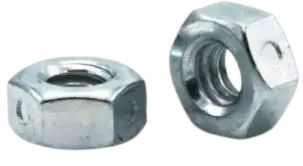
Center locknuts feature a distorted thread in the center of the nut that creates a locking mechanism. This design allows the nut to be installed from either side and provides a secure hold against vibrations or rotations.
How They Work
- Instead of a separate locking component, center lock nuts have indentations or deformations worked into the internal threads within the center of the nut.
- These distortions increase friction and grip on the mating bolt or screw, which stops the locknuts from loosening.
Key Characteristics & Advantages
- Installation flexibility: Center locknuts can be installed on either side.
- Faster installations: The ability to be installed from either side creates a faster assembly process, especially on production lines.
- Heat resistant: These locknuts are ideal for high-temperature and corrosive environments, since they’re made of steel or stainless steel
- Shorter screws: Bolts or screws used with these locknuts can be shorter since the locking mechanism is in the center of the locknut.
Our experts are standing by to help you choose the right locknuts for your project’s needs. Get in touch with us today.